
Is Australia’s Housing Supply Really What the Numbers Suggest? A Perth & Mandurah Perspective
Every week, new headlines shout about “record house prices”, “more homes coming to market” and “thousands of dwellings approved”. On paper, it can sound like Australia – and Western Australia in particular – is awash with housing.
But for the average buyer in Perth or Mandurah trying to get into their first home, it doesn’t feel that way at all.
This article takes a neutral, big-picture look at how housing supply is measured, how investors and policy settings shape what’s really available, and how local zoning decisions in suburbs like Coodanup and Greenfields could unlock more genuine housing options – without destroying lifestyle in surrounding semi-rural areas.
Jump to:
- 1. The Headline Numbers: Record Prices, Tight Listings
- 2. What Actually Counts as “Available Housing”?
- 3. How Much of the Market Do Investors Really Hold?
- 4. A Policy Thought Experiment: What If the Rules Changed?
- 5. Mandurah Case Study: Density, Rezoning and Suburb Futures
- 6. Why the Media Story Feels Different to Lived Reality
- 7. Final Thoughts: Asking Better Questions About Supply
1. The Headline Numbers: Record Prices, Tight Listings
Nationally, Australian home prices have continued to climb. By late 2025, the median dwelling value reached record highs, with prices rising around 6% or more across the year in a context of tight supply and renewed demand after interest rate cuts.1 Perth has consistently been one of the strongest-performing capitals, with annual growth in the double digits and a median house price in Greater Perth sitting in the low-to-mid $800,000s by October 2025.2
At the same time, rental vacancy rates – a key indicator of how much stock is truly available – have hovered around 2–2.7% in Perth through 2025, only just approaching what REIWA considers a “balanced” rental market (2.5–3.5%).3,4 That means there is still far more demand than supply in the rental space, and in many suburbs in and around Mandurah, vacancy has often sat well below even those levels.
On paper, the housing system is huge: ABS data shows there are over 11 million residential dwellings in Australia, with total dwelling values around $11 trillion.5,6 But those headline figures tell us almost nothing about how many of those dwellings are realistically available to everyday buyers in Perth and Mandurah.
2. What Actually Counts as “Available Housing”?
When governments and commentators talk about “housing supply”, the numbers often lump together very different types of properties and markets. That can give a false impression of how much is really accessible to a typical household.
Over-55 Villages and Retirement Communities
Across Perth and the Mandurah region, there are significant pockets of over-55 villages, retirement communities and lifestyle estates. These dwellings are usually:
- restricted to specific age groups or life stages
- structured under leasehold, licence or village contracts rather than standard freehold titles
- subject to unique fees, rules and exit arrangements
These properties are counted in the total dwelling stock, but they are not part of the open market in the same way as a standard house in Lakelands, Dudley Park or Meadow Springs.
Ultra-High-Price Suburbs Outside the Normal Buyer Pool
Suburbs like Dalkeith, Peppermint Grove, Applecross and Ardross now regularly see prices in the $2–5 million-plus range. These postcodes are effectively their own market: small, tightly held, and priced far beyond the reach of median-income buyers.
They are technically “supply”, but they’re not the supply most West Australians are competing over. Including these markets in broad statistics can skew perceptions of average values and mask how little genuinely affordable, family-suitable stock exists under, say, $800,000.
Pre-Sold New Builds and SMSF-Owned Stock
Another layer of complexity comes from new builds and off-the-plan projects. Many townhouses, apartments and house-and-land packages are pre-sold to self-managed super funds (SMSFs) or individual investors before they ever hit mainstream sales channels.
These dwellings may be:
- held long-term as rental stock
- kept vacant for periods for tax or investment reasons
- treated primarily as financial products, not homes for owner-occupiers
Again, they are counted in dwelling numbers, but the way they’re financed and held means they don’t function like typical owner-occupied homes in the market, especially for first-home buyers.
3. How Much of the Market Do Investors Really Hold?
Australia has a large and powerful investor segment in residential property. According to ABS-based lending data, around 37% of housing loans in 2024–2025 were investor loans – up from roughly a third just a couple of years earlier.7 More recent figures suggest that, in 2025, property investors accounted for roughly two in every five new home loans nationally – about 40% of new lending.8
Crucially, not all of that lending is funding new housing. Analysis cited by economists shows that only around 20–25% of investor borrowing is for new construction; the majority is used to purchase existing homes, which does not increase overall housing supply.9
At the ownership level, only a minority of Australians own investment properties at all, but a very small group owns a large number of them, with some investors holding five, six or more properties each.10
None of this automatically makes investors “good” or “bad” – they provide rental housing and take financial risks. But it does raise the question: when we count total dwellings and talk about “tight supply”, how much of that stock is effectively locked behind investment strategies, tax settings and portfolio decisions that the average first-home buyer cannot compete with?
4. A Policy Thought Experiment: What If the Rules Changed?
Rather than taking a political stance, it’s useful to treat housing policy as a thought experiment. If the goal is to increase the number of homes that everyday Australians can realistically buy and live in, what kinds of rule changes might actually free up supply?
Below are neutral scenarios – not prescriptions, but questions worth exploring.
Scenario 1: Caps on the Number of Investment Properties per Person
What if there was a cap on the number of residential properties an individual or entity could own?
Potential effects might include:
- some large portfolio owners selling down investment stock
- more established homes hitting the open market for owner-occupiers
- greater distribution of ownership across more households
Risks could include investor exit from certain markets, a temporary shock to prices, or reduced private rental stock in the short term. Any such policy would need careful staging and transition planning.
Scenario 2: Restructuring or Removing Negative Gearing
Negative gearing has long been a central feature of Australian property investing. Removing or significantly reshaping it could:
- reduce incentives to hold highly leveraged investment properties
- encourage investors to focus on positively geared, higher-yield opportunities
- push some existing properties onto the market as investors reassess portfolios
At the same time, such a move could be politically unpopular and would need measures to protect long-term mum-and-dad investors, especially those close to retirement.
Scenario 3: Retargeting Tax Benefits and Incentives Towards Non-Owners
Instead of tax benefits flowing primarily to existing investors, incentives could be designed to support:
- first-home buyers who have never owned a property
- long-term renters transitioning into ownership
- shared-equity or co-ownership models that reduce entry costs
The question becomes: if the same billions currently spent or foregone via tax concessions were redirected towards genuine first-home buyer pathways, how many additional households could be helped into ownership?
Scenario 4: Tightening Foreign Ownership of Residential Property
Another thought is to limit foreign residential investment to specific, clearly defined purposes – for example, high-skilled worker accommodation held under government or quasi-public ownership, rather than private portfolios.
In theory, this could reduce speculative demand in certain markets and direct more of the existing stock to local residents and citizens. In practice, it would need to be balanced against broader economic, diplomatic and investment considerations.
Scenario 5: A One-Off Investor Exit Scheme
If governments were willing to intervene at scale, they could create a one-time scheme that:
- offers a partial bailout or tax offset to investors who sell within a fixed timeframe
- encourages the transfer of properties from investor portfolios into owner-occupier hands
- temporarily boosts supply and eases prices
This would be controversial, but it’s not fundamentally different from past examples where public money has been used to stabilise banks or other industries. The question is not whether it is politically easy, but whether it would be more effective than existing schemes in getting non-owners into homes.
None of these scenarios are simple. All of them involve trade-offs. But they highlight how much of the “supply” issue is governed by policy choices, not just by how many dwellings physically exist.
5. Mandurah Case Study: Density, Rezoning and Suburb Futures
Zooming in from the national picture to Mandurah and its surrounds, there is another lever that rarely gets proper public discussion: strategic rezoning and density in the right suburbs.
Coodanup and Greenfields as Future Inner-City Suburbs
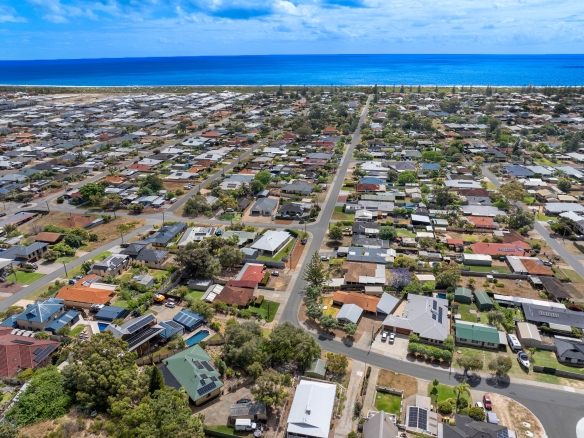
If Mandurah continues to grow and evolve as a coastal city, suburbs like Coodanup and Greenfields are effectively its “inner ring” – close to services, transport links and employment corridors.
Thoughtfully increasing density in parts of these suburbs could:
- unlock more housing stock on existing serviced land
- create new opportunities for existing owners to subdivide, build or sell to developers
- add a wider mix of housing types (villas, townhouses, small apartment blocks) at more accessible price points
From a planning perspective, these areas are far better suited to higher density than pushing endless new estates further and further out, where infrastructure and transport are weaker.
Protecting Semi-Rural Lifestyle in Parklands, Barragup and Beyond
The goal doesn’t have to be blanket infill everywhere. Semi-rural areas like Parklands, Barragup, Furnissdale and similar pockets can continue to provide a different lifestyle offering – larger blocks, hobby farms, space and privacy.
In that scenario, you have:
- higher-density, well-serviced inner suburbs like parts of Coodanup and Greenfields helping to absorb population growth, and
- protected semi-rural zones that retain character and long-term lifestyle appeal.
Existing homeowners in rezoned areas can win in multiple ways:
- those who choose to subdivide or redevelop gain a new income or capital growth avenue
- those who do nothing still benefit from the scarcity value of holding a larger block in an increasingly subdivided area
For first-home buyers, more medium-density options close to services generally mean more choice and, potentially, slightly lower entry prices than standalone houses on large blocks.
6. Why the Media Story Feels Different to Lived Reality
When you put everything together, it becomes clearer why many Australians feel like the housing story they see in the media doesn’t match their lived experience:
- headline supply figures include over-55 villages, ultra-premium suburbs and pre-sold investor stock
- a large share of new lending is going to investors, not first-home buyers
- only a fraction of investor borrowing funds new housing; most goes into existing stock
- local planning often under-utilises inner-suburb density opportunities while pushing sprawl to the edges
So when an article says “listings are up” or “X thousand dwellings approved”, a fair question for everyday buyers is:
“How many of those homes will realistically ever be available at a price point and in a location I can actually live in?”
7. Final Thoughts: Asking Better Questions About Supply
Australia does not just have a housing affordability problem; it has a housing allocation and policy problem.
Simply counting dwellings is no longer good enough. A serious conversation about supply needs to distinguish between:
- homes that are physically built vs homes that are genuinely accessible to local residents
- stock held primarily as an investment vehicle vs stock functioning as someone’s home
- suburbs that are permanently out of reach vs suburbs where smart planning could unlock more opportunity
Neutral questions like:
- Should we cap how many investment properties one person can own?
- Should negative gearing and tax benefits be restructured to favour non-owners?
- Should foreign residential investment be more tightly focused on clear national goals?
- Should inner suburbs like Coodanup and Greenfields be strategically rezoned to increase stock while protecting semi-rural areas like Parklands and Barragup?
won’t be answered overnight. But asking them – rather than just accepting headline supply figures at face value – is a necessary first step if we genuinely want more Australians who don’t yet own a home to get one.
Ultimately, housing is more than a market. It’s where people live their lives. Any serious solution has to start from that point.

Join The Discussion